
Quick answer: Genetics account for around 5–10% of breast cancer cases, with inherited mutations like BRCA1 and BRCA2 carrying the highest individual risk. Most cases result from a combination of age, hormonal exposure, and lifestyle factors — many of which you can understand, monitor, and, in some cases, influence. Knowing your personal risk profile is the first step toward proactive, informed care.
If it feels like you’re hearing about breast cancer more often than you used to, you’re not imagining it. Awareness campaigns are louder, screening programmes reach more women, and conversations about family history and genetic testing have become far more common at the GP’s office. But does this mean breast cancer itself is becoming more prevalent — or are we simply getting better at finding it?
For many women, especially those navigating hormonal changes, PCOS, or premenopausal symptoms, this question isn’t academic. It shapes real decisions about contraception, hormone therapy, and family planning. This guide breaks down what the evidence actually shows about breast cancer risk factors, separating what’s within your genetic makeup from what choices and circumstances influence — without judgement, and without unnecessary alarm.
Is breast cancer becoming more common, or are we just detecting it better?
Both things are true, to some extent. Improved mammography access and more women attending routine screening mean cancers are caught earlier, sometimes before symptoms even appear. This naturally increases the number of recorded diagnoses.
At the same time, genuine rises in incidence have occurred. Lifestyle shifts — such as delayed childbearing, changes in body weight, and alcohol consumption — play a role, as does an ageing population. According to Cancer Research UK, breast cancer incidence rates have risen over recent decades, though survival rates have also improved significantly thanks to earlier detection and better treatment (Cancer Research UK, 2023).
The takeaway here is reassuring rather than frightening: more diagnoses often reflect better vigilance, not simply a more dangerous world.
How much of breast cancer risk is actually genetic?
This is one of the most common questions we hear, and understandably so. Inherited genetic mutations — most notably in the BRCA1 and BRCA2 genes — account for approximately 5–10% of all breast cancer cases (National Cancer Institute, 2020).
Women carrying a BRCA1 mutation face an estimated 55–72% lifetime risk of developing breast cancer, while BRCA2 carriers face a risk of around 45–69% (Kuchenbaecker et al., 2017). Both figures are significantly higher than the average woman’s lifetime risk of roughly 1 in 7 in the UK (Cancer Research UK, 2023).
Having a family history of breast cancer doesn’t automatically mean you carry one of these mutations. Most breast cancers, even those that seem to “run in families,” don’t link to a single identifiable gene. Rather, they arise from a complex interplay of genetics, hormones, and environment. If you’re concerned about your family history, genetic counselling can help clarify your personal risk and whether testing is right for you.
What proportion of breast cancer is genuinely preventable?
Since genetics explain only a small slice of the picture, it’s worth asking how much risk relates to modifiable factors. The World Cancer Research Fund estimates that around 23–28% of breast cancer cases in high-income countries could be prevented through changes such as maintaining a healthy weight, limiting alcohol intake, staying physically active, and breastfeeding where possible (World Cancer Research Fund, 2018).
It’s important to frame this carefully: “preventable” does not mean “your fault.” Breast cancer results from many overlapping factors, several of which — like age, genetics, and hormonal history — sit entirely outside anyone’s control. Understanding modifiable risk is about empowerment, not blame.
Does breastfeeding really reduce breast cancer risk?
Yes, and the evidence here is fairly consistent. A landmark collaborative analysis found that breast cancer risk fell by around 4.3% for every 12 months of breastfeeding, on top of a separate reduction linked to each birth (Collaborative Group on Hormonal Factors in Breast Cancer, 2002).
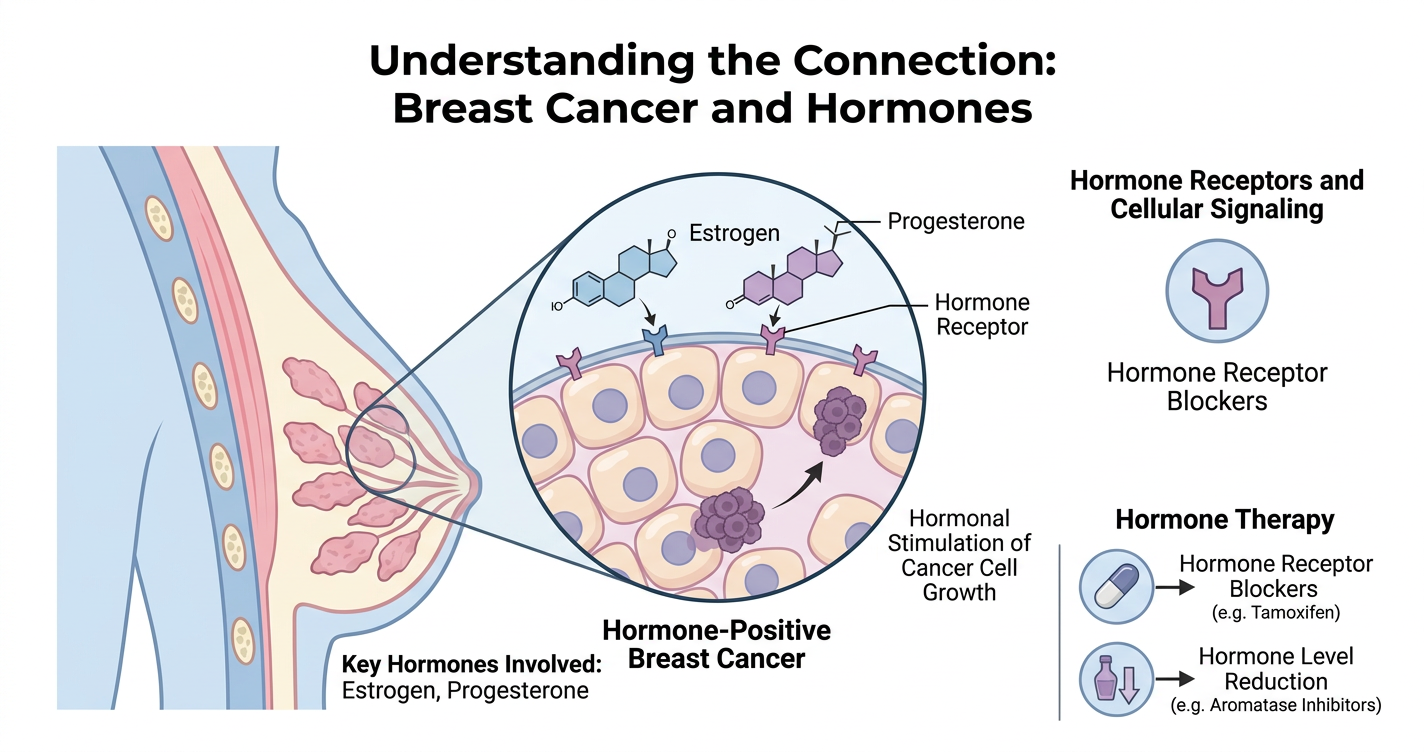
Researchers believe this relates to reduced lifetime oestrogen exposure, since breastfeeding delays the return of ovulation after childbirth. That said, women who don’t or can’t breastfeed shouldn’t feel concerned. This effect is one contributing factor among many, and personal circumstances around feeding choices involve far more than cancer risk.
Why is not having children associated with higher breast cancer risk?
Nulliparity — the medical term for not having given birth — consistently links to a modestly increased breast cancer risk in research. Women who have children, particularly before the age of 30, tend to have slightly lower lifetime risk compared with those who haven’t given birth (Kelsey, Gammon and John, 1993).
The explanation centres on hormonal exposure. Pregnancy causes breast cells to mature in ways that may make them more resistant to cancerous changes later in life, and it reduces the total number of menstrual cycles — and therefore oestrogen exposure — over a woman’s lifetime.
Here’s what’s important to keep in mind: this is a statistical association across large populations, not a personal verdict. Many women without children never develop breast cancer, and many who do have children still face other risk factors. Family planning is a deeply personal decision that shouldn’t be driven by cancer statistics alone.
What about the contraceptive pill and breast cancer risk?
Research links combined oral contraceptives to a small, temporary increase in breast cancer risk during use, with this risk gradually returning to baseline within roughly ten years of stopping (Mørch et al., 2017). The same research shows the pill offers protective effects against ovarian and endometrial cancers, sometimes lasting decades after use.
For most women, the absolute increase in risk is small. Since breast cancer is relatively rare in younger women, a modest relative increase translates into a small number of additional cases overall. Rather than a reason to avoid contraception, this is a conversation worth having with your GP or clinician, factoring in your personal and family history.
If you’re currently weighing up hormone therapy options for perimenopause and want to understand how HRT specifically factors into breast cancer risk, our companion article on HRT and breast cancer risk covers this in more depth.
What does this mean for you, practically?
Understanding your risk isn’t about creating anxiety — it’s about giving you clarity to make informed choices. A few practical steps worth considering:
- Know your family history. If close relatives have had breast or ovarian cancer, particularly at a young age, mention this to your GP.
- Attend routine screening. Early detection remains one of the most powerful tools available.
- Focus on what you can influence. Maintaining a healthy weight, moderating alcohol, and staying active all contribute to lower risk, alongside broader health benefits.
- Discuss contraception and hormone therapy with a specialist. Personalised guidance accounts for your unique risk profile, not just population averages.
- Consider genetic counselling if indicated. This is especially relevant if you have a strong family history or ancestry associated with higher BRCA prevalence.
You deserve support that’s tailored to your circumstances, not generic advice based on fear.
Ready to understand your personal risk profile?
Navigating breast cancer risk factors alongside hormonal health concerns can feel overwhelming — but you don’t have to work it out alone. At Amber Green Clinics, our team offers personalised guidance that brings together your genetics, lifestyle, and hormonal health, so you can make confident, informed decisions.
Book a free 30-minute discovery call with Amber Green Clinics today, and let’s talk through what your personal risk picture really looks like. 💚
Frequently asked questions
Is breast cancer mostly genetic or environmental?
Genetics account for around 5–10% of breast cancer cases, primarily through inherited mutations like BRCA1 and BRCA2. A combination of age, hormonal history, and lifestyle-related factors drives most cases, rather than a single inherited cause.
What is my risk if I carry a BRCA1 or BRCA2 mutation?
Women with a BRCA1 mutation face an estimated 55–72% lifetime risk of breast cancer, while BRCA2 carriers face around 45–69%, compared to roughly 1 in 7 for the general population (Kuchenbaecker et al., 2017; Cancer Research UK, 2023).
Does not having children increase breast cancer risk?
Research shows a modest association between nulliparity and slightly higher breast cancer risk, likely linked to lifetime oestrogen exposure. This is a population-level statistical pattern, not a personal prediction.
Does the contraceptive pill increase breast cancer risk?
Combined oral contraceptives link to a small, temporary increase in risk during use, which returns to baseline within about ten years of stopping. The pill also reduces the risk of ovarian and endometrial cancers.
How can I reduce my breast cancer risk?
Maintaining a healthy weight, limiting alcohol, staying physically active, breastfeeding where possible, and attending regular screening all associate with lower risk. Personalised medical guidance based on your family history adds another important layer of support.
References
Cancer Research UK (2023) Breast cancer statistics. Available at: https://www.cancerresearchuk.org/health-professional/cancer-statistics/statistics-by-cancer-type/breast-cancer (Accessed: 4 September 2026).
Collaborative Group on Hormonal Factors in Breast Cancer (2002) ‘Breast cancer and breastfeeding: collaborative reanalysis of individual data from 47 epidemiological studies in 30 countries, including 50302 women with breast cancer and 96973 women without the disease’, The Lancet, 360(9328), pp. 187–195.
Kelsey, J.L., Gammon, M.D. and John, E.M. (1993) ‘Reproductive factors and breast cancer’, Epidemiologic Reviews, 15(1), pp. 36–47.
Kuchenbaecker, K.B. et al. (2017) ‘Risks of breast, ovarian, and contralateral breast cancer for BRCA1 and BRCA2 mutation carriers’, JAMA, 317(23), pp. 2402–2416.
Mørch, L.S. et al. (2017) ‘Contemporary hormonal contraception and the risk of breast cancer’, New England Journal of Medicine, 377(23), pp. 2228–2239.
National Cancer Institute (2020) BRCA gene mutations: cancer risk and genetic testing. Available at: https://www.cancer.gov/about-cancer/causes-prevention/genetics/brca-fact-sheet (Accessed: 4 September 2026).
World Cancer Research Fund (2018) Breast cancer statistics and prevention. Available at: https://www.wcrf.org/cancer-trends/breast-cancer-statistics/ (Accessed: 4 September 2026).