
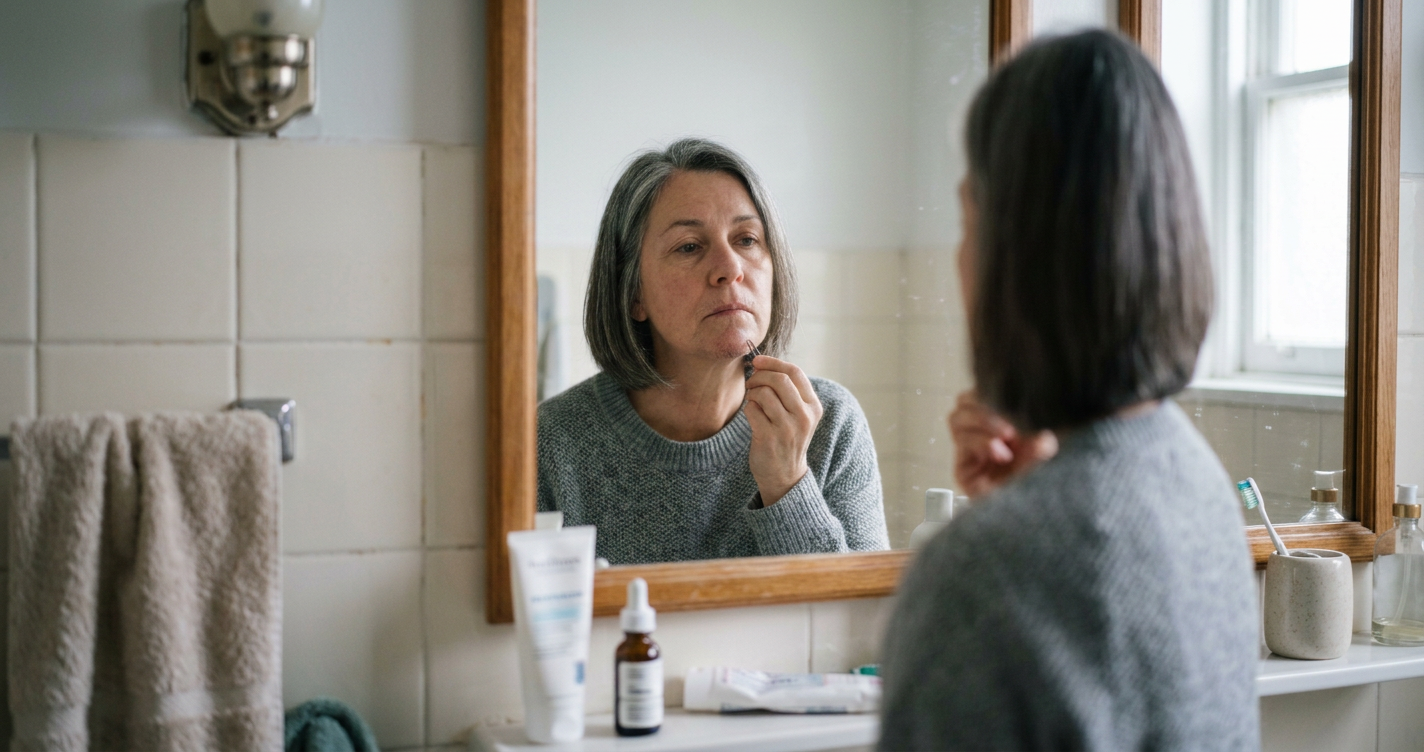
Quick answer: Coarse, dark facial hair at menopause is common and usually caused by a hormonal shift. As oestrogen falls, testosterone becomes more dominant, prompting fine facial hair to grow thicker and darker. This is called hirsutism. In most cases it’s harmless, and effective treatments — from prescription creams to hormone therapy — can help you manage it.
You catch your reflection in the car mirror at the traffic lights, and there it is — a dark, wiry hair on your chin that definitely wasn’t there before. If this sounds familiar, you are far from alone. Many women notice coarse facial hair appearing on the chin, upper lip, or jawline during perimenopause and after menopause.
The medical term for this is hirsutism, meaning excess hair growth in areas where men typically grow hair. It can feel distressing, and it often arrives alongside other changes that make midlife feel unfamiliar. But understanding why it happens is the first step towards feeling in control again.
In this article, we’ll explain the hormonal reason behind coarse facial hair at menopause, help you know when it’s worth getting checked, bust a common myth about plucking, and walk you through the treatments that genuinely work. Everything here is grounded in clinical evidence — no scare tactics, just clear, practical guidance.
Why does facial hair appear or increase at menopause?
The change comes down to a shift in the balance between your hormones, rather than a sudden surge of “male” hormones.
Throughout your reproductive years, oestrogen is the dominant hormone. As you move through perimenopause and into menopause, oestrogen levels fall significantly. Testosterone, which women produce in small amounts too, declines far more gradually. The result is a relative rise in testosterone’s influence, even though the actual amount hasn’t necessarily increased (Hirschberg, 2023).
A protein called sex hormone-binding globulin (SHBG) plays a key role here. SHBG binds to testosterone in the bloodstream and keeps it inactive. As oestrogen drops, SHBG levels also fall — which means more “free” testosterone is available to act on your body’s tissues (Martin et al., 2018).
Some of that free testosterone is converted into a more potent hormone called dihydrotestosterone (DHT) at the hair follicle. DHT stimulates fine, pale facial hair to transform into the coarse, dark hairs many women notice at midlife. So the culprit isn’t one thing — it’s the combined effect of falling oestrogen, lower SHBG, more free testosterone, and DHT at the follicle.
Is coarse facial hair normal, or should it be checked?
For most women, gradual facial hair growth at menopause is a normal part of the hormonal transition. It typically appears slowly over months or years and stays fairly mild.
That said, some patterns do warrant a conversation with a specialist. It’s worth getting checked if you notice:
- Sudden or rapid onset of coarse hair over weeks rather than months
- Severe growth that appears alongside other symptoms
- Signs of increased androgen activity, such as a deepening voice, thinning hair on your scalp, acne, or unexplained weight changes
- Irregular changes that feel out of step with your menopause journey
These warning signs can occasionally point to an underlying condition affecting hormone levels, and they deserve proper assessment (Martin et al., 2018). A quick check can bring reassurance — and if something does need attention, catching it early is always best.
If you’re unsure where your symptoms sit on this spectrum, speaking with a hormone specialist can help you understand your own picture rather than guessing.
Does plucking make hair grow back thicker?
This is one of the most persistent beauty myths — and the good news is that it’s simply not true.
Plucking, shaving, or trimming a hair does not change the structure of the follicle beneath the skin. The follicle determines how thick, dark, or coarse a hair grows, and physical removal at the surface doesn’t alter it. Hair may feel stubbly as it regrows because it’s been cut to a blunt edge, but it isn’t genuinely thicker or darker (British Association of Dermatologists, 2016).
So if you enjoy plucking a stray chin hair, there’s no need to worry that you’re making the problem worse. What physical removal doesn’t do, however, is address the hormonal cause — which is where the more lasting treatments come in.
What actually works: the evidence on treatment
There’s no single “best” option. The right approach depends on how much hair you have, your overall menopause picture, and your personal preferences. Here’s what the evidence supports.
Topical prescription cream (eflornithine)
Eflornithine is a prescription cream applied directly to the affected area. It works by slowing the rate of hair growth rather than removing hair, so it’s often used alongside other methods. Results build gradually, and hair growth usually returns if you stop using it. It’s a good choice if you’d prefer a targeted, non-hormonal option (British Association of Dermatologists, 2016).
Anti-androgen medication (spironolactone)
Spironolactone is a medication that blocks the effect of androgens like testosterone at the hair follicle. Because it tackles the hormonal driver, it can reduce coarse hair over time — though it typically takes several months to see the benefit. It requires a prescription and monitoring by a clinician (Martin et al., 2018).
Choose spironolactone if the hormonal cause matters more to you than a purely cosmetic fix, and you’re comfortable with an ongoing prescription.
Hormone replacement therapy (HRT)
HRT replaces the oestrogen your body is no longer producing, which can help restore SHBG levels and rebalance the oestrogen-to-testosterone ratio. While HRT is prescribed primarily to manage menopause symptoms such as hot flushes and low mood, its effect on hormone balance may also help with hair changes for some women (Hirschberg, 2023). It’s worth discussing as part of a wider treatment plan rather than as a standalone fix for facial hair.
Physical hair removal (laser, electrolysis, waxing, threading, shaving)
Physical methods remove hair you can already see:
- Laser hair removal targets the pigment in the hair and can offer long-lasting reduction, though it works best on darker hairs.
- Electrolysis treats hairs individually and is the only method considered permanent.
- Waxing, threading, and shaving are quick, affordable, and effective for managing hair at home or in a salon.
These methods are ideal if you want visible results quickly, and they pair well with treatments that address the hormonal cause (Wolf et al., 2007).
Bringing it together
Coarse facial hair at menopause isn’t a personal failing or a sign that something is seriously wrong — it’s a predictable response to falling oestrogen and the changing balance of hormones in your body. Once you understand the “why,” the “what to do” becomes far less daunting.
Physical hair removal handles what you can see. Prescription treatments like eflornithine and spironolactone, and in some cases HRT, address the underlying hormonal picture. For many women, a combination works best. And crucially, the right plan is the one that fits your symptoms, your lifestyle, and your goals.
Key takeaways
- It’s common and usually harmless. Coarse facial hair at menopause is caused by falling oestrogen, lower SHBG, and more active testosterone and DHT.
- Sudden or severe changes deserve a check. Rapid growth or signs like a deepening voice or scalp thinning should be assessed by a specialist.
- Plucking is a myth. Physical removal doesn’t make hair grow back thicker or darker.
- Effective treatments exist. Options include eflornithine cream, spironolactone, HRT, and physical removal such as laser or electrolysis.
- A tailored plan works best. The most effective approach usually combines managing visible hair with addressing the hormonal cause.
Ready to understand your own hormonal picture?
You don’t have to work this out alone. At Amber Green Clinics, our specialist team takes the time to understand your symptoms and build a treatment plan tailored to you — because you deserve to feel like yourself again. 💚
Book your free discovery call today and let’s talk through what’s really going on and which options are right for you.
Frequently asked questions
Why do I suddenly have chin hair after menopause?
Chin hair after menopause is caused by a hormonal shift. As oestrogen falls, levels of sex hormone-binding globulin drop too, leaving more free testosterone to act on your hair follicles. This can turn fine, pale hair into coarse, dark hair — most noticeably on the chin, upper lip, and jawline.
Is facial hair a sign of high testosterone?
Not necessarily. In most menopausal women, testosterone levels haven’t risen — oestrogen has simply fallen, making testosterone’s effect more dominant. However, sudden or severe hair growth alongside symptoms like acne or a deepening voice can indicate raised androgen activity and should be assessed by a specialist.
Does plucking chin hair make it grow back thicker?
No. Plucking, shaving, or trimming doesn’t change the follicle, so it can’t make hair grow back thicker or darker. Regrowth may feel stubbly because it’s been cut bluntly, but the hair itself is unchanged.
What is the best treatment for menopausal facial hair?
There’s no single best treatment — it depends on your symptoms and preferences. Options include eflornithine cream to slow growth, spironolactone to block androgens, HRT to rebalance hormones, and physical removal such as laser or electrolysis. Many women find a combination most effective, which a hormone specialist can help you plan.
Can HRT help with facial hair at menopause?
HRT can help by restoring oestrogen and improving your hormone balance, which may reduce hair changes for some women. It’s mainly prescribed to manage menopause symptoms overall, so it’s best discussed as part of a wider treatment plan rather than as a standalone solution for facial hair.
References
British Association of Dermatologists (2016) Hirsutism: Patient Information Leaflet. London: British Association of Dermatologists.
Hirschberg, A.L. (2023) ‘Approach to investigation of hyperandrogenism in a postmenopausal woman’, The Journal of Clinical Endocrinology & Metabolism, 108(5), pp. 1243–1253.
Martin, K.A., Anderson, R.R., Chang, R.J., Ehrmann, D.A., Lobo, R.A., Murad, M.H., Pugeat, M.M. and Rosenfield, R.L. (2018) ‘Evaluation and treatment of hirsutism in premenopausal women: an Endocrine Society clinical practice guideline’, The Journal of Clinical Endocrinology & Metabolism, 103(4), pp. 1233–1257.
Wolf, J.E., Shander, D., Huber, F., Jackson, J., Lin, C.S., Mathes, B.M. and Schrode, K. (2007) ‘Randomized, double-blind clinical evaluation of the efficacy and safety of topical eflornithine HCl 13.9% cream in the treatment of women with facial hair’, International Journal of Dermatology, 46(1), pp. 94–98.