
Quick answer: Falling oestrogen during perimenopause and menopause directly changes your skin. Lower oestrogen means less collagen, less moisture and weaker skin barrier function — leading to dryness, itching, new lines and even adult acne. The good news? Understanding the science helps you choose treatments that genuinely work.
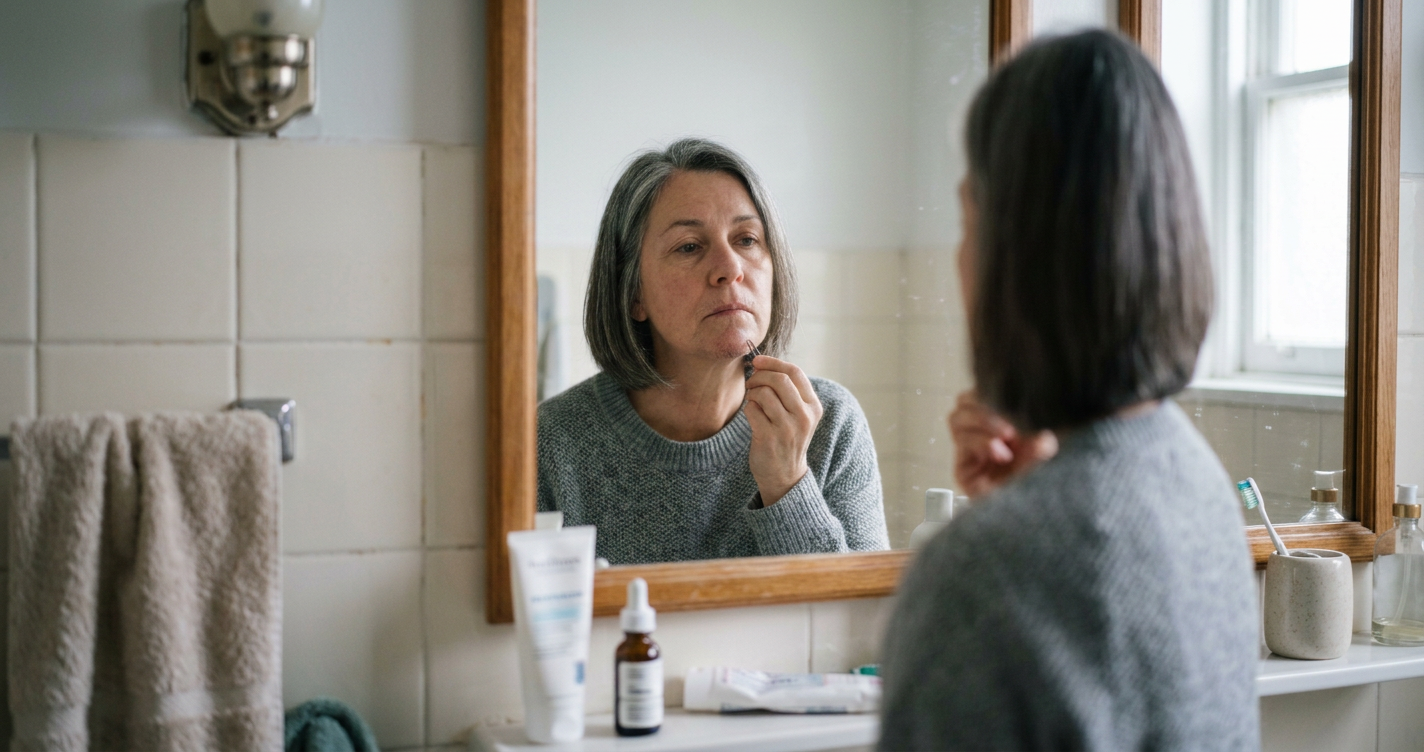
Have you looked in the mirror lately and wondered where your skin went? Maybe it feels drier than it used to. Perhaps fine lines seem to have appeared overnight, or spots have returned for the first time since your teens. You are not imagining it, and you are certainly not alone.
For many women over 35, these changes arrive around the same time as other perimenopausal signs — disrupted sleep, mood shifts, or irregular periods. That timing is no coincidence. Your skin is one of the largest organs in your body, and it responds to your hormones just as much as your mood or your menstrual cycle does.
This article explains the real link between your hormones and your skin. We will look at why oestrogen matters so much, what causes dryness and breakouts, and what is actually happening as your skin ages. Most importantly, we will explore which treatments have genuine evidence behind them — so you can feel confident about the choices you make.
Why Does Oestrogen Matter So Much to Your Skin?
Oestrogen is one of the most important hormones for healthy, resilient skin. It helps your body produce collagen, the protein that keeps skin firm and plump. It also supports the production of natural oils and helps your skin hold onto moisture.
Research shows just how closely the two are linked. Brincat et al. (1987) found that skin collagen content is directly related to a woman’s oestrogen levels and declines after menopause. In other words, when oestrogen falls, collagen follows.
So as your oestrogen levels drop during perimenopause and menopause, your skin loses some of its natural support system. This single change sits behind many of the differences you may be noticing.
Why Does Your Skin Suddenly Feel Dry, Tight or Itchy?
Dry, tight or itchy skin is one of the most common complaints during perimenopause — and there is a clear reason for it.
Oestrogen helps your skin stay hydrated by supporting molecules that draw in and hold water. Verdier-Sévrain, Bonté and Gilchrest (2006) explain that oestrogen influences skin thickness, hydration and barrier function. When levels fall, your skin holds less moisture and its protective barrier weakens.
The result is skin that feels drier, more sensitive and sometimes itchy for no obvious reason. You might find your usual moisturiser no longer feels like enough, or that skin on your arms and legs feels rough and tight. This is your skin barrier asking for extra support.
Why Can Adult Acne Appear or Worsen in Perimenopause?
If breakouts have returned in your 40s, it can feel deeply unfair. Wasn’t acne supposed to stay in your teenage years?
Here is what is happening. During perimenopause, oestrogen falls while testosterone stays relatively steady. This shift changes the balance between the two. With less oestrogen to keep it in check, testosterone can have a stronger effect — stimulating oil glands and contributing to spots, particularly around the jaw and chin.
Khunger and Mehrotra (2019) describe how this hormonal shift drives menopausal acne, which often appears on the lower face. It is a real, hormone-driven change — not a sign you are doing anything wrong with your skincare.
What Is Actually Happening to Ageing Skin?
Skin ageing is partly about time and sun exposure. But at midlife, hormones add another powerful layer.
As oestrogen declines, your skin becomes thinner and loses collagen more quickly. Raine-Fenning, Brincat and Muscat-Baron (2003) report that skin can lose around 30% of its collagen in the first five years after menopause, with a slower decline continuing afterwards. That rapid early loss helps explain why so many women feel their skin changed “all at once”.
Less collagen means less structure and firmness. This is why fine lines, reduced elasticity and a thinner-feeling texture often become noticeable in a relatively short space of time.
Does HRT Improve Skin? What the Evidence Actually Shows
This is one of the most common questions we hear — and the evidence is genuinely encouraging.
Because oestrogen supports collagen and hydration, replacing it can help protect the skin. Sator et al. (2001) found that hormone replacement therapy improved skin hydration, elasticity and thickness in postmenopausal women. Other research supports the idea that oestrogen helps maintain collagen and skin quality over time.
It is important to be clear about what this means. HRT is a medical treatment prescribed for menopausal symptoms and overall health, not a cosmetic product. Improved skin can be a welcome benefit for many women, but the decision to use HRT should always be made with a specialist, based on your full health picture.
Choose a specialist consultation if you want to understand whether HRT is right for you — including its potential effects on your skin, alongside your wider symptoms and health history.
What About the Hundreds of Anti-Ageing Creams on the Market?
Walk into any pharmacy and you will find shelves of creams promising to turn back the clock. So do they work?
Some ingredients do have solid evidence behind them. Retinoids can support collagen, well-formulated moisturisers can strengthen the skin barrier, and daily sunscreen remains one of the most effective ways to protect against ageing. These are genuinely worthwhile.
But there is a limit. Most creams work on the surface of the skin. They cannot replace the oestrogen that drives collagen production from within. That is why a good skincare routine helps — yet often cannot fully reverse hormone-related changes on its own. Knowing this helps you spend wisely and set realistic expectations.
Bringing It Together
Your skin changes at midlife because your hormones change. Falling oestrogen reduces collagen, moisture and barrier strength, which explains dryness, itching, thinning and new lines. A shift in the balance between oestrogen and testosterone can bring back acne.
None of this is a personal failing, and none of it means you are stuck. When you understand what is driving the changes, you can make calmer, better-informed choices — combining sensible skincare with medical options where they are appropriate for you.
Key Takeaways
- Oestrogen is central to skin health, supporting collagen, moisture and barrier function (Brincat et al., 1987).
- Dryness and itching are common because falling oestrogen weakens the skin’s ability to hold water (Verdier-Sévrain, Bonté and Gilchrest, 2006).
- Perimenopausal acne is driven by a shift in the oestrogen–testosterone balance (Khunger and Mehrotra, 2019).
- Collagen loss is rapid early on, with around 30% lost in the first five years after menopause (Raine-Fenning, Brincat and Muscat-Baron, 2003).
- HRT can improve skin hydration, elasticity and thickness, but is a medical decision made with a specialist (Sator et al., 2001).
- Creams have real but limited benefits and cannot replace oestrogen lost from within.
Ready to Understand Your Own Skin and Hormone Picture?
Your skin is telling you something — and you deserve answers that go beyond the beauty aisle. As specialists in dermatological health during menopause, our team at Amber Green Clinics is uniquely placed to help restore your skin and support it through every hormonal change. We look at the whole picture, connecting your skin changes to your wider hormonal health so you can feel like yourself again. 💚
Book your free discovery call today. It is a relaxed, no-pressure conversation with our clinical team, and a first step towards care that is truly tailored for you.
Frequently Asked Questions
Can menopause really cause dry, itchy skin?
Yes. As oestrogen falls during perimenopause and menopause, your skin holds less moisture and its protective barrier weakens. This often leads to dryness, tightness and itching, even in areas you never had trouble with before.
Why am I getting acne in my 40s?
Perimenopausal acne happens because oestrogen drops while testosterone stays relatively stable. This shift lets testosterone stimulate oil glands more strongly, often causing spots around the jaw and chin (Khunger and Mehrotra, 2019).
Does HRT help with skin ageing?
Research suggests it can. Sator et al. (2001) found HRT improved skin hydration, elasticity and thickness in postmenopausal women. However, HRT is prescribed for menopausal symptoms and health, not as a cosmetic treatment, so it should be discussed with a specialist.
How much collagen do you lose after menopause?
Studies indicate skin can lose around 30% of its collagen in the first five years after menopause, with a slower decline afterwards (Raine-Fenning, Brincat and Muscat-Baron, 2003). This helps explain why skin can change so quickly at midlife.
Are expensive anti-ageing creams worth it?
Some ingredients, such as retinoids and sunscreen, have good evidence behind them and are worth using. But creams work mainly on the skin’s surface and cannot replace the oestrogen that drives collagen from within, so their effect on hormone-related changes is limited.
Who should consider a specialist consultation for menopausal skin changes?
If dryness, itching, breakouts or rapid skin ageing are bothering you — especially alongside other perimenopausal symptoms — a specialist can help. A consultation looks at your full hormonal picture and helps you weigh options such as HRT and skincare together.
References
Brincat, M., Moniz, C.F., Studd, J.W.W., Darby, A.J., Magos, A. and Cooper, D. (1987) ‘Sex hormones and skin collagen content in postmenopausal women’, British Medical Journal, 294(6567), pp. 764–765.
Khunger, N. and Mehrotra, K. (2019) ‘Menopausal acne – challenges and solutions’, International Journal of Women’s Health, 11, pp. 555–567.
Raine-Fenning, N.J., Brincat, M.P. and Muscat-Baron, Y. (2003) ‘Skin ageing and menopause: implications for treatment’, American Journal of Clinical Dermatology, 4(6), pp. 371–378.
Sator, P.G., Schmidt, J.B., Sator, M.O., Huber, J.C. and Hönigsmann, H. (2001) ‘The influence of hormone replacement therapy on skin ageing: a pilot study’, Maturitas, 39(1), pp. 43–55.
Verdier-Sévrain, S., Bonté, F. and Gilchrest, B. (2006) ‘Biology of estrogens in skin: implications for skin ageing’, Experimental Dermatology, 15(2), pp. 83–94.