
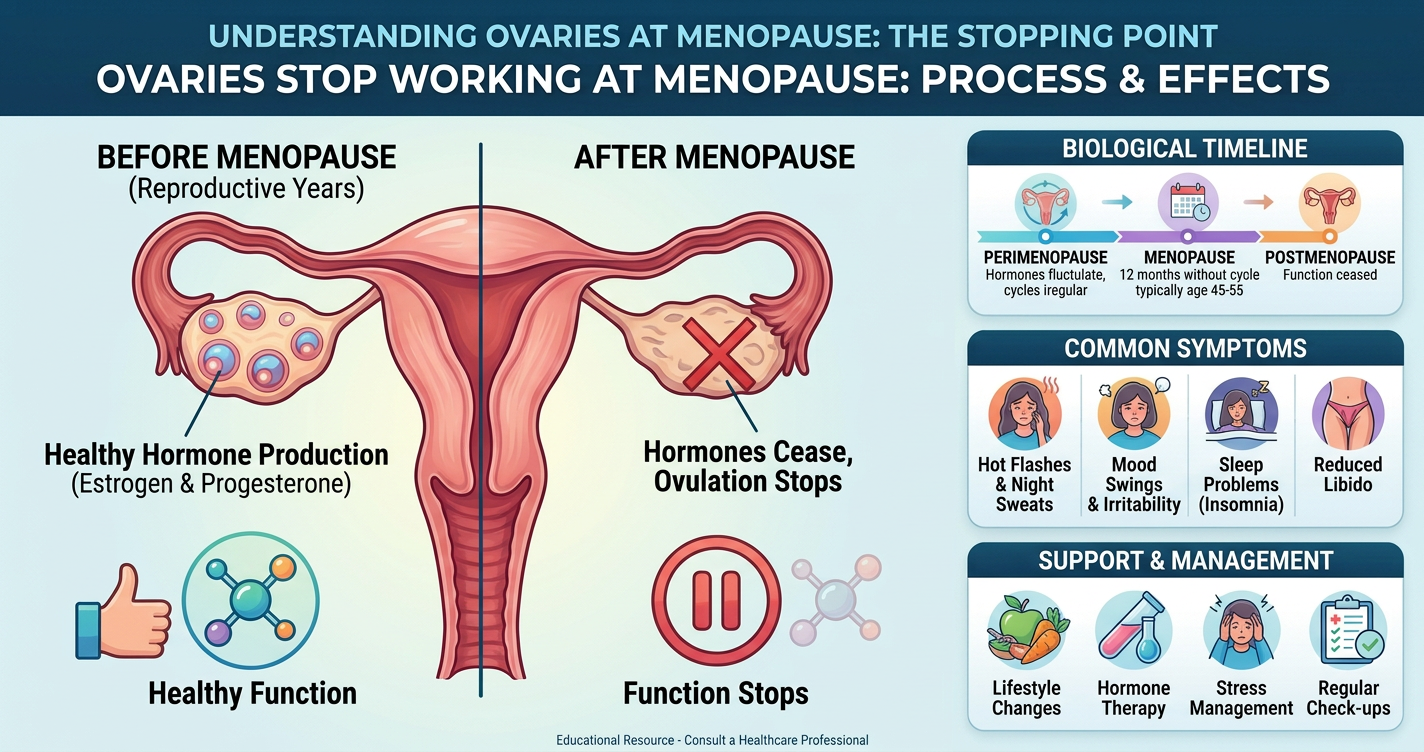
Quick answer: Menopause doesn’t switch your ovaries off completely. Your ovaries carry on making small amounts of androgens, which your body turns into oestrogen in fat tissue and elsewhere. Hormone levels do drop — but it’s not as simple as flicking a switch.
Many people picture menopause like a light going out — hormones on, then suddenly off. It’s easy to think that way. Periods stop. Fertility ends. Your body changes in ways that can feel fast and unsettling.
But what’s actually happening is more gradual.
Your hormones don’t disappear overnight. Your body slowly shifts how and where it makes oestrogen, progesterone, and other key hormones. Knowing what really happens — to your ovaries, your hormone levels, and your overall health — can help you feel more confident about your care.
What Actually Happens to Your Ovaries at Menopause?
Menopause means you’ve gone 12 months in a row without a period. It usually happens between ages 45 and 55. At this point, your ovaries have used up their supply of follicles — the tiny structures that release eggs and make most of your reproductive hormones.
As follicle numbers fall during perimenopause, oestradiol (the main form of oestrogen during your fertile years) drops sharply. Your brain tries to push the ovaries harder by releasing more follicle-stimulating hormone (FSH) — but the ovaries simply don’t respond the way they used to. Burger et al. (2007) found that rising FSH alongside falling oestradiol is one of the clearest signs of the menopause shift.
What your ovaries do not do is shut down completely.
Do Your Ovaries Still Make Oestrogen After Menopause?
This is one of the most important — and most misunderstood — things about hormonal health after menopause.
After menopause, your ovaries carry on making androgens, mainly androstenedione and testosterone. Your body then turns these androgens into oestrone (a milder form of oestrogen) in fat tissue, skin, and muscle. This process is called peripheral aromatisation, and it becomes your main source of oestrogen after menopause (Simpson, 2003).
So the answer to “do ovaries still make oestrogen after menopause?” is: not directly, no — but they do feed into the process. Your ovaries keep making androgens, which your body then converts.
How much oestrone your body makes varies from person to person. Body composition plays a part — women with more fat tissue tend to convert more androgens into oestrogen. That’s not a reason to seek more body fat, but it does explain why oestrogen levels after menopause differ so much between women.
Labrie (2015) also showed that hormones can act locally within specific tissues, meaning your body’s oestrogen activity after menopause is even more varied than we once thought.
What About Progesterone After Menopause?
Progesterone comes mainly from the corpus luteum — a short-lived structure in the ovary that forms after ovulation. When ovulation stops, that source goes with it.
Unlike oestrogen, there’s no backup process to keep progesterone going after menopause. Levels fall very low, often to near-zero (Santoro et al., 2021). This matters a great deal if you’re thinking about HRT, because without progesterone — and with oestrogen still present at low levels — the womb lining can be at risk.
Women who still have a womb and take oestrogen as part of HRT also need to take a progestogen to protect the womb lining. NICE (2019) is clear on this, recommending combined HRT for women with a uterus to reduce the risk of endometrial hyperplasia (thickening of the womb lining).
Are You ‘Deficient’ for the Rest of Your Life?
The word “deficiency” feels heavy. It suggests something is broken or wrong. The truth is more nuanced.
Your body lowers hormone levels after menopause on purpose — it no longer needs to support a reproductive cycle. But the effects of that shift are real: weaker bones, changes to heart health, brain fog, poor sleep, and vaginal or bladder discomfort, among others.
Whether those lower hormone levels count as a “deficiency” that needs treating depends entirely on you. For many women, the drop is significant enough to cause symptoms that get in the way of everyday life. For others, the change is more gradual and less disruptive. There’s no single cut-off point that determines when treatment makes sense — which is exactly why a personal assessment matters so much.
It helps to think of hormonal health after menopause not as a diagnosis, but as a picture shaped by your symptoms, your health history, and what you want your health to look like going forward.
What This Means for Your Care
Understanding what your ovaries still do after menopause changes how you might think about your options.
If your ovaries are still producing some hormones — just not enough to ease symptoms or protect your health long-term — then HRT isn’t about replacing something that has completely disappeared. It’s about bringing levels back to a range that supports your wellbeing, based on your own needs.
NICE (2019) recommends that HRT should be considered for women with menopausal symptoms when the benefits outweigh the risks — and that every woman’s situation should guide that decision. There’s no one-size-fits-all answer.
The key things that shape the right plan for you include:
- Your symptoms – what you’re feeling and how much it affects your day-to-day life
- Your health history – including your heart, bone, and breast health
- Your preferences – how you’d like to take hormones, and how often you want to check in
- Your goals – whether you want symptom relief, long-term protection, or both
A specialist who looks at the full picture — not just one hormone in isolation — can walk you through your options with care and confidence.
Key Takeaways
- Menopause stops your ovaries from releasing eggs, but they carry on making androgens that your body converts to oestrogen
- After menopause, oestrone (made from those androgens in fat tissue) becomes your main source of oestrogen
- Progesterone drops to very low levels after menopause, with no backup process to top it up
- Your hormone levels after menopause are shaped by your body composition, age, and other personal factors
- Whether you need hormonal support depends on your symptoms, health history, and goals — not a blanket label of “deficiency”
- NICE (2019) supports HRT after menopause where it’s right for the individual, and recommends a tailored approach
Your Hormonal Health Deserves a Closer Look
If you’ve been wondering whether your symptoms are “normal,” whether your hormones have “run out,” or whether HRT might be right for you — you deserve clear, honest answers. Not guesswork. Not generalisations.
At Amber Green Clinics, our specialist team takes the time to understand your full hormonal picture. We look at your hormone levels, listen to your concerns, and build a treatment plan that fits your life. We’re here for you every step of the way.
Book your free 30-minute discovery call today. No pressure, no obligation — just a warm, expert conversation about your health and what’s possible. 💚
Frequently Asked Questions
Do the ovaries completely stop working after menopause?
No. They stop releasing eggs and making significant amounts of oestradiol, but they carry on making androgens — mainly androstenedione and testosterone — which your body converts to oestrone. Ovarian function after menopause is reduced, not gone.
Where does oestrogen come from after menopause?
Mainly from fat tissue, skin, and muscle, where androgens from the ovaries and adrenal glands get converted into oestrone. Oestrone is a milder form of oestrogen than the oestradiol your body made during your fertile years.
Is it normal to have almost no progesterone after menopause?
Yes. Progesterone comes from the corpus luteum after ovulation. Once ovulation stops, progesterone levels drop and stay very low. Unlike oestrogen, there’s no other process in the body that can top it up.
Does everyone need HRT after menopause?
No. Whether HRT is right for you depends on your symptoms, your health history, and your goals. NICE (2019) recommends looking at each woman’s situation individually rather than taking a blanket approach.
Can hormonal symptoms carry on years after menopause?
Yes. Many women still deal with vaginal dryness, bone changes, low mood, and poor sleep well into the postmenopausal years. These can all link back to lower hormone levels, and specialist support can make a real difference.
How do I know if my hormone levels need attention?
A specialist consultation — with hormone blood tests — gives you a clear picture of where your levels sit and how they relate to what you’re feeling. This forms the starting point for any personal care plan.
References
Burger, H.G., Hale, G.E., Dennerstein, L. and Robertson, D.M. (2007) ‘Cycle and hormone changes during perimenopause: the key role of ovarian function’, Menopause, 14(1), pp. 35–44.
Labrie, F. (2015) ‘All sex steroids are made intracellularly in peripheral tissues by the mechanisms of intracrinology after menopause’, Journal of Steroid Biochemistry and Molecular Biology, 145, pp. 133–138.
National Institute for Health and Care Excellence (NICE) (2019) Menopause: diagnosis and management [NG23]. London: NICE. Available at: https://www.nice.org.uk/guidance/ng23
Santoro, N., Roeca, C., Peters, B.A. and Neal-Perry, G. (2021) ‘The menopause transition: signs, symptoms, and management options’, Journal of Clinical Endocrinology & Metabolism, 106(1), pp. 1–15.
Simpson, E.R. (2003) ‘Sources of oestrogen and their importance’, Journal of Steroid Biochemistry and Molecular Biology, 86(3–5), pp. 225–230.