
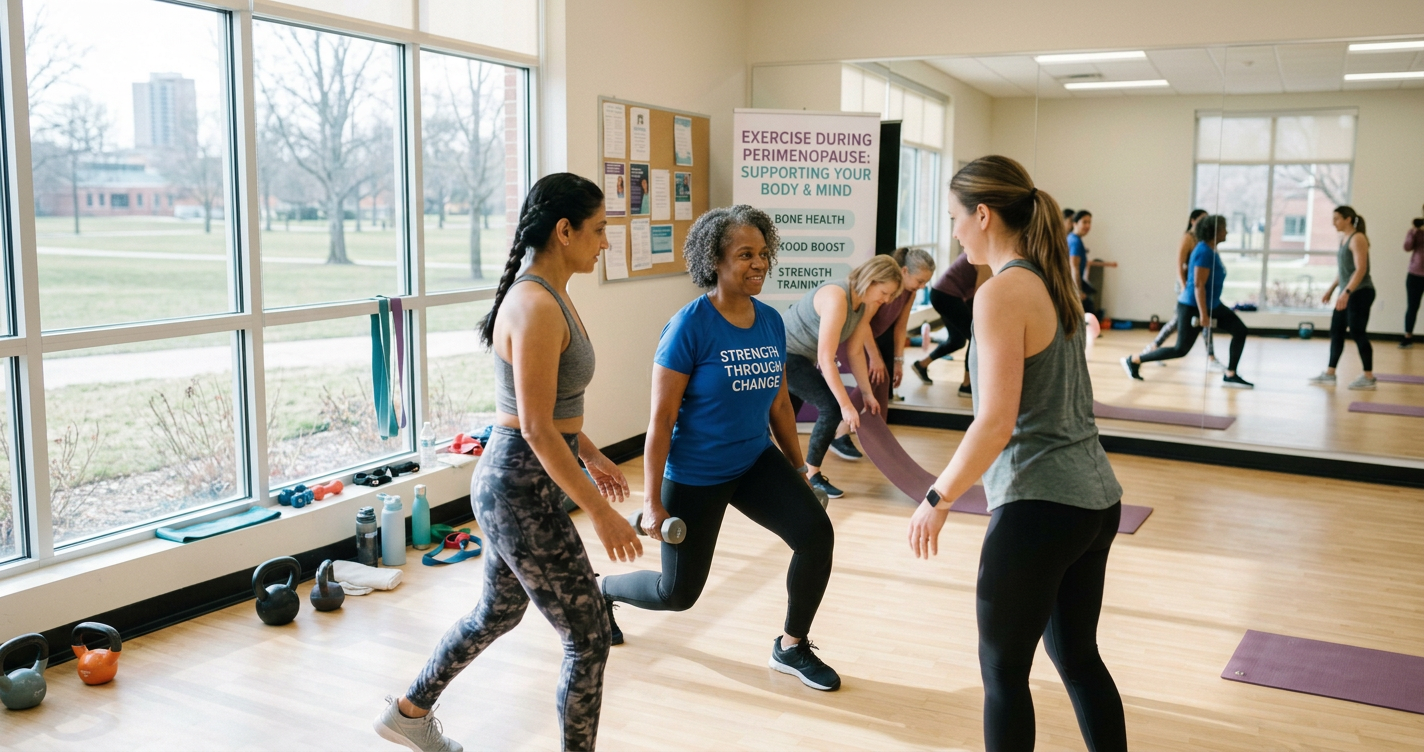
Quick answer: During perimenopause and menopause, the UK Chief Medical Officers recommend at least 150 minutes of moderate aerobic activity per week, plus strength training at least twice a week. Strength training is the most important type of exercise at this life stage—cardio alone is not enough to protect your muscle mass, bones, and cardiovascular health as oestrogen declines.
One of the most common questions the team at Amber Green Clinics hears is this: “How much exercise do I actually need—and what kind?” It sounds simple. The answer is a little more nuanced.
Why does falling oestrogen make exercise more important—not less?
Oestrogen does far more than regulate your cycle. It actively protects your muscle mass, bone density, and cardiovascular system. As oestrogen declines during perimenopause, all three take a hit. Research by Sipilä et al. (2020) confirms that both muscle and bone mass decrease significantly during the menopause transition—a process that begins earlier than most women expect, often in their early-to-mid forties.
This is precisely why staying active during this stage matters so much. Exercise for menopause is not about aesthetics or weight loss (though it can support both). It is about protecting your body from the inside out.
How much exercise do you need during perimenopause and menopause?
The UK Chief Medical Officers’ Physical Activity Guidelines (Department of Health and Social Care, 2019) recommend:
- 150 minutes of moderate-intensity aerobic activity per week (e.g. brisk walking, swimming, cycling)
- Strength training at least twice a week, targeting all major muscle groups
These guidelines apply to all adults—but for women in perimenopause and menopause, the strength training component carries particular weight. Muscle mass directly supports bone health, metabolic function, and insulin sensitivity. Missing it out and focusing on cardio alone leaves a significant gap.
What is the best combination of exercise during menopause—yoga, strength training, swimming, or running?
All movement has value, but not all movement offers equal protection at this life stage. Here is how the main types break down:
- Strength training (resistance machines, free weights, bodyweight exercises): The highest priority. Strength training for menopause directly counters muscle loss, supports bone density, and helps manage body composition changes.
- Weight-bearing cardio (brisk walking, running, dancing, hiking): Stimulates bone remodelling in a way that non-weight-bearing exercise cannot. Running and walking are both effective.
- Swimming and cycling: Excellent for cardiovascular health and joint-friendly options if you have knee or hip pain—but they do not load the skeleton in the same way, so they work best alongside weight-bearing activity.
- Yoga and mobility work: Supports flexibility, balance, posture, and stress reduction. Valuable as a complement to the above, particularly for sleep and mood.
If you can only prioritise one thing, choose strength training. Build from there.
Does housework count as exercise during menopause?
Gardening, carrying shopping, cleaning, taking the stairs—this kind of everyday movement is known as NEAT (Non-Exercise Activity Thermogenesis), and it absolutely contributes to your overall health. Staying generally active throughout the day matters.
However, NEAT does not replace structured progressive resistance training. Housework does not consistently challenge your muscles in the way that is needed to maintain or build strength. For that, you need deliberate, progressive overload—gradually increasing the demand placed on your muscles over time.
Think of NEAT as the foundation and structured exercise as the structure built on top of it.
Does exercise help with hot flushes?
Here is an honest answer: the evidence is mixed. The Cochrane review by Daley et al. (2014) found no conclusive evidence that exercise reliably reduces the frequency or severity of vasomotor symptoms such as hot flushes and night sweats.
That does not mean exercise has no value—far from it. The evidence for exercise improving mood, sleep quality, cardiovascular health, bone density, and muscle mass during menopause is considerably stronger. For many women, these benefits alone transform how they feel day to day. Manage expectations around hot flushes specifically, but do not let that hold you back from moving.
What should you look for in a personal trainer during perimenopause?
Not all personal trainers understand this life stage, and working with one who does makes a meaningful difference. When choosing a trainer, ask:
- Do they have specific experience or training in menopause or hormonal health?
- Can they tailor programming around fatigue, joint sensitivity, and recovery needs?
- Do they work alongside a clinical team, rather than in isolation?
At Amber Green Clinics, our specialist Personal Trainer works directly alongside the clinical team—so your exercise programme reflects your hormonal picture, not just your fitness level. That joined-up approach is rare, and it matters.
The Bottom Line
Aim for 150 minutes of moderate cardio per week, plus strength training at least twice a week. Prioritise progressive resistance training above all else. Add weight-bearing cardio, yoga, and everyday movement to build a well-rounded routine.
Start where you are. Consistency matters far more than perfection.
Ready to build a plan that works for your body?
If you would like personalised guidance on exercise, hormonal health, or HRT, the team at Amber Green Clinics is here to help. Book a free consultation at ambergreenclinics.com or call us on 020 8050 4959. Our specialist Personal Trainer and clinical team work together to create a plan that fits your life—and your hormones.
Frequently Asked Questions
How much exercise do I need during perimenopause?
The UK Chief Medical Officers (2019) recommend at least 150 minutes of moderate aerobic activity and two sessions of strength training per week. During perimenopause, the strength training component is especially important for protecting muscle mass and bone density as oestrogen levels decline (Sipilä et al., 2020).
What is the best exercise for menopause weight gain?
Strength training is the most effective exercise for managing body composition during menopause. Building and maintaining muscle mass supports a healthy metabolism. Combining resistance training with weight-bearing cardio such as brisk walking or running gives the best overall results.
Does exercise reduce hot flushes during menopause?
The evidence here is limited. The Cochrane review by Daley et al. (2014) found no conclusive evidence that exercise reliably reduces hot flushes. However, exercise does show strong evidence for improving mood, sleep, cardiovascular health, and bone and muscle strength during menopause.
Can I start strength training during perimenopause if I have never done it before?
Yes. It is never too late to start, and many women begin resistance training for the first time during perimenopause with excellent results. Starting gradually and working with a trainer who understands hormonal health will help you progress safely and consistently.
Should I see a specialist before starting an exercise programme during menopause?
If you have any underlying health conditions, joint problems, or significant symptoms, speaking with a healthcare professional before starting a new programme is sensible. A specialist clinic like Amber Green Clinics can assess your hormonal health alongside your fitness goals and create a truly integrated plan.
References
- Daley, A., Stokes-Lampard, H., Thomas, A., & Macarthur, C. (2014). Exercise for vasomotor menopausal symptoms. Cochrane Database of Systematic Reviews, Issue 11.
- Department of Health and Social Care. (2019). UK Chief Medical Officers’ Physical Activity Guidelines. Crown Copyright.
- Sipilä, S., Taaffe, D. R., Cheng, S., Mikkola, T. M., Niskala, A., & Narici, M. (2020). Effects of hormone replacement therapy and high-impact physical exercise on skeletal muscle in post-menopausal women: a randomised placebo-controlled study. Clinical Science, 134(11), 1403–1416.
This article is for educational purposes and does not constitute medical advice. Please consult a qualified healthcare professional before making any decisions about your treatment.