
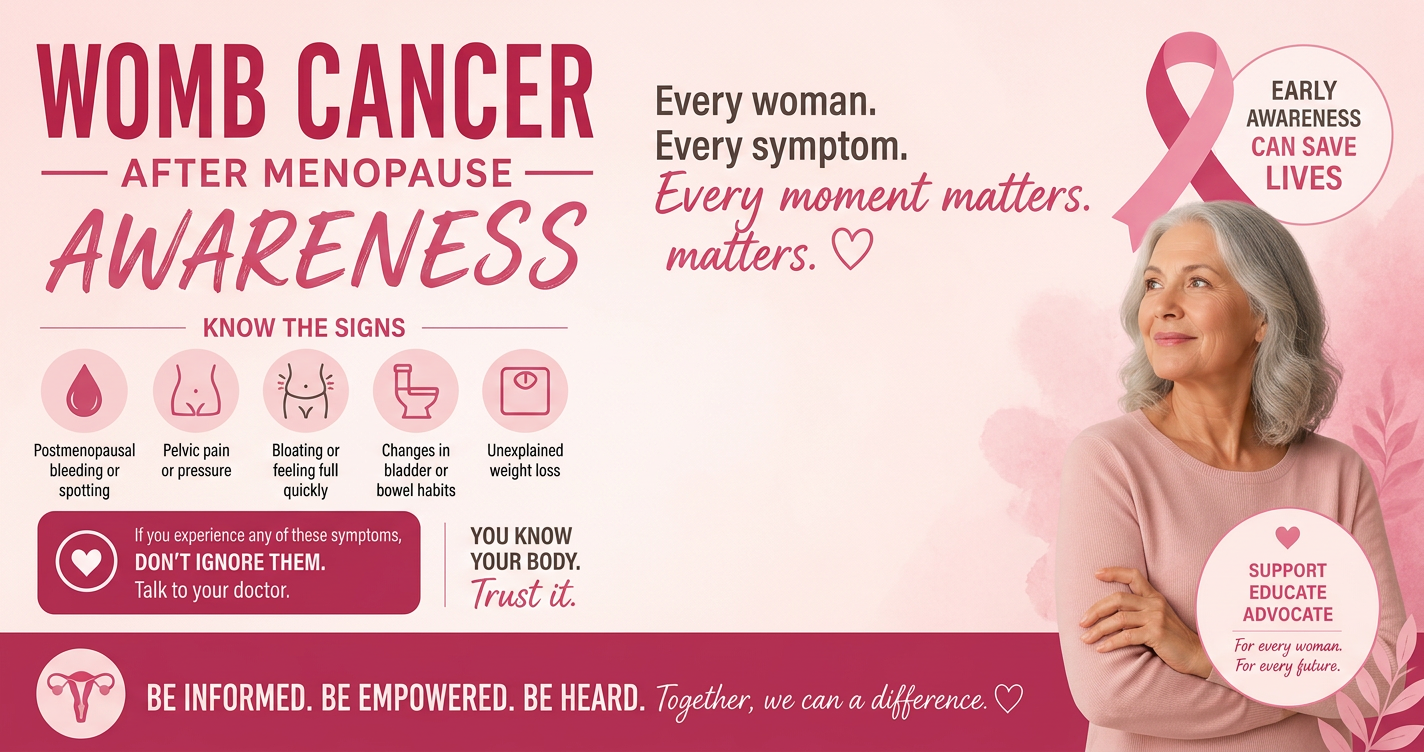
Womb Cancer After Menopause: Risk, Warning Signs & Protection
TL;DR: Endometrial (womb) cancer is the most common gynaecological cancer in the UK, and the majority of cases occur after menopause. The single biggest modifiable risk factor is excess body weight, which drives oestrogen production independently of the ovaries. Never ignore postmenopausal bleeding — it’s the key warning sign and always warrants prompt investigation.
Endometrial cancer — cancer of the lining of the womb — affects around 10,000 women in the UK every year, making it the most common gynaecological cancer in the country (Cancer Research UK, 2025). What many women don’t realise is that the risk doesn’t arrive with menopause itself. For most, it rises because of what menopause changes: the delicate hormonal balance that has been regulating the womb lining for decades.
The good news is that endometrial cancer is also one of the more detectable cancers when caught early. Understanding your personal risk — and knowing the one symptom that should never be ignored — can make all the difference.
This article walks through the key risk factors for womb cancer after menopause, including the role of body weight, HRT, tamoxifen, and the contraceptive pill. You’ll also find out what screening is (and isn’t) available, and what practical steps you can take right now.
Why Does Menopause Increase the Risk of Womb Cancer?
The endometrium — the inner lining of the uterus — is exquisitely sensitive to hormones. Throughout your reproductive years, oestrogen stimulates the lining to thicken each month, while progesterone counteracts that effect, triggering a monthly shed. This balance keeps the endometrium in check.
After menopause, ovarian production of both hormones drops dramatically. Oestrogen, however, doesn’t disappear entirely — fat tissue continues to produce it, and without progesterone to oppose it, that oestrogen can still stimulate the endometrium. This is what clinicians mean by “unopposed oestrogen”: oestrogen acting on the womb lining without the balancing effect of progesterone.
Over time, unopposed oestrogen can cause endometrial cells to proliferate abnormally — a process known as endometrial hyperplasia — which, if left unchecked, can progress to cancer. Clinicians describe this as the central mechanism connecting post-menopause hormonal changes to womb cancer risk.
Why Is Body Weight the Single Biggest Modifiable Risk Factor for Endometrial Cancer?
Of all the factors that influence womb cancer risk, body weight is the one most within your control — and the evidence behind it is substantial.
Far from being metabolically inert, fat tissue (adipose tissue) actively converts androgens into oestrogen through a process called aromatisation. The more adipose tissue a woman carries, the more oestrogen her body produces after menopause — and without progesterone to balance it, that oestrogen acts directly on the womb lining.
A major meta-analysis published in The Lancet by Renehan et al. (2008) found that each 5 kg/m² increase in BMI was associated with a 59% increase in the risk of endometrial cancer in women — one of the strongest dose-response relationships between obesity and any cancer type.
Insulin resistance, which commonly accompanies excess weight, compounds this effect. Elevated insulin levels stimulate the ovaries and adrenal glands to produce more androgens, which the body then converts to oestrogen. Raised insulin also reduces levels of sex hormone-binding globulin (SHBG), leaving more oestrogen “free” and biologically active.
The preventability angle here is meaningful. Maintaining a healthy weight through midlife and beyond is one of the most evidence-based steps a woman can take to reduce her womb cancer risk — alongside the clinical interventions discussed below.
Does the Contraceptive Pill Offer Any Lasting Protection Against Womb Cancer?
The combined oral contraceptive pill — which contains both oestrogen and a progestogen — has a well-established protective effect against endometrial cancer. Its progestogen component opposes oestrogen’s stimulating effect on the womb lining, reducing the risk of abnormal cell growth.
Crucially, this protection appears to persist long after a woman stops taking the pill. Studies suggest that women who used the combined pill for five or more years continue to have a meaningfully lower risk of endometrial cancer for decades afterwards. For women approaching menopause who used the pill earlier in life, this is worth knowing — though it does not, of course, eliminate risk entirely or replace the need for symptom awareness.
Is There a Screening Test for Endometrial Cancer?
This is one of the most common questions women ask — and the honest answer is: not yet.
Unlike cervical cancer (screened through smear tests) or breast cancer (screened through mammograms), the UK currently has no national screening programme for endometrial cancer. Clinicians do not routinely offer ultrasound or biopsy to asymptomatic postmenopausal women as standard practice.
That’s precisely what makes symptom awareness so critical.
Postmenopausal bleeding is the key warning sign. Any vaginal bleeding that occurs 12 or more months after your last period should be investigated without delay. NICE guideline NG12 (2026) recommends that women aged 55 and over with postmenopausal bleeding receive referral on a suspected cancer pathway, with investigation within two weeks.
Worth emphasising: postmenopausal bleeding is not always cancer. Many benign causes exist, including endometrial polyps and atrophic changes — but clinicians must always investigate it. A symptom that is easily explained away is often the one that gets dismissed for too long.
What Should Women Taking Tamoxifen Know About Womb Cancer Risk?
Tamoxifen is a widely used treatment for oestrogen receptor-positive breast cancer. It works in the breast as an oestrogen blocker — but in the womb lining, it behaves differently, acting more like an oestrogen. This oestrogen-like effect on the endometrium is why tamoxifen use raises the risk of endometrial cancer and endometrial polyps.
Current evidence does not support routine surveillance ultrasound for asymptomatic women taking tamoxifen, so clinicians do not generally recommend it unless symptoms arise. However, you should report any unusual vaginal bleeding, discharge, or pelvic pain to your clinical team promptly — don’t wait for a scheduled appointment.
If you are postmenopausal and taking tamoxifen, make sure both your oncology and gynaecology teams have your full picture, and that you know clearly which symptoms to watch for.
Where Does HRT Fit Into the Picture?
Hormone replacement therapy is an effective and, for many women, life-changing treatment for menopausal symptoms. The type of HRT you take, however, matters significantly when it comes to womb cancer risk.
Oestrogen-only HRT, prescribed without a progestogen, carries a meaningfully elevated risk of endometrial cancer for women who have a uterus. Without opposition, oestrogen stimulates the womb lining unchecked — the same mechanism described earlier. For this reason, clinicians only prescribe oestrogen-only HRT to women who have had a hysterectomy.
Combined HRT — oestrogen paired with a progestogen — is the standard approach for women with a uterus. The progestogen protects the endometrium by opposing oestrogen’s proliferative effects. Taken correctly and consistently, combined HRT does not appear to significantly increase endometrial cancer risk compared with no HRT.
One practical point: if you are on combined HRT and experience any unexpected bleeding — particularly bleeding that doesn’t follow the expected pattern of your regimen — flag it with your prescriber. It may well be nothing, but a clinician should assess it. At Amber Green Clinics, HRT prescribing includes ongoing monitoring precisely because getting the regimen right is not a one-time decision.
What Can You Actually Do With This Information?
Knowledge is most useful when it translates into action. Here are the practical takeaways from everything covered above:
- Manage your weight. Maintaining a healthy BMI reduces unopposed oestrogen levels after menopause and lowers endometrial cancer risk. Even modest weight reduction in women with obesity has meaningful hormonal effects.
- Know the warning sign. Postmenopausal bleeding — any bleeding 12 or more months after your last period — must be investigated. Contact your GP and ask for an urgent referral under the two-week wait pathway if needed.
- If you take tamoxifen, report any vaginal bleeding, abnormal discharge, or pelvic pain to your clinical team promptly. Do not wait.
- Review your HRT regimen. If you have a uterus, oestrogen-only HRT is not appropriate for you. If you are unsure what type you are taking, ask your prescriber.
- Don’t rely on screening. No routine screening programme for endometrial cancer exists in the UK. Symptom awareness is your best early-detection tool.
- Know your risk factors. Family history of endometrial or colorectal cancer (Lynch syndrome), early onset of periods, late menopause, and conditions such as polycystic ovary syndrome (PCOS) can all elevate risk. Discuss your personal history with a clinician.
Ready to Talk Through Your Risk?
Understanding your hormonal health after menopause is not something you should have to navigate alone. At Amber Green Clinics, our specialist team — led by a Consultant Pharmacist and Independent Prescriber with deep expertise in HRT and menopause care — is here to listen, review your full picture, and provide clear, evidence-based guidance tailored to you.
Whether you have concerns about your HRT regimen, want to understand your personal risk factors, or simply want a thorough conversation with someone who will take your symptoms seriously, we are here for you.
Book a consultation at ambergreenclinics.com or call the clinic on 020 8050 4959. We offer both in-person and remote appointments across the UK — no GP referral needed.
Your health deserves expert attention. Take the first step today. 💚
Frequently Asked Questions
What is the most common symptom of womb cancer after menopause?
Postmenopausal bleeding — any vaginal bleeding occurring 12 or more months after the final menstrual period — is the most important warning sign of endometrial cancer. NICE guideline NG12 (2026) recommends that women aged 55 and over with this symptom receive referral on a suspected cancer pathway within two weeks. Bleeding does not always mean cancer, but a clinician must always investigate it.
Does obesity cause endometrial cancer after menopause?
Excess body weight is the single biggest modifiable risk factor for endometrial cancer after menopause. Fat tissue produces oestrogen independently of the ovaries, and without progesterone to counterbalance it, this oestrogen stimulates the womb lining abnormally. Renehan et al. (2008) in The Lancet found that each 5 kg/m² rise in BMI is associated with a 59% higher risk of endometrial cancer in women.
Is there a screening programme for endometrial cancer in the UK?
No. As of 2026, the UK has no national screening programme for endometrial cancer. Unlike cervical or breast cancer, no routine test exists for asymptomatic women — which makes awareness of postmenopausal bleeding as a warning sign especially important.
Does HRT increase the risk of womb cancer?
The risk depends on the type of HRT. Oestrogen-only HRT — when taken by women who still have a uterus — raises the risk of endometrial cancer, because oestrogen stimulates the womb lining without opposition. Combined HRT, which includes a progestogen, significantly reduces this risk. Women with a uterus should not take oestrogen-only HRT.
Why does tamoxifen increase the risk of endometrial cancer?
Tamoxifen blocks oestrogen in breast tissue, but exerts an oestrogen-like effect on the womb lining. This stimulates endometrial cell growth and raises the risk of endometrial polyps and cancer. Women taking tamoxifen should report any postmenopausal bleeding, abnormal discharge, or pelvic pain to their clinical team without delay.
Does the contraceptive pill protect against womb cancer?
Yes — the combined oral contraceptive pill provides a protective effect against endometrial cancer, primarily through its progestogen component. This protection persists for many years after stopping the pill. Prior pill use does not eliminate risk entirely, however, and symptom awareness remains essential.
Who is most at risk of endometrial cancer after menopause?
Risk is higher in women who are overweight or obese, have a history of unopposed oestrogen exposure (including oestrogen-only HRT), have never been pregnant, have had a late menopause, or have a personal or family history of Lynch syndrome or colorectal cancer, or are taking tamoxifen. Discussing your personal risk profile with a qualified clinician is the most effective way to understand your individual situation.
References
- Cancer Research UK. Uterine cancer statistics. 2025. Available at: cancerresearchuk.org
- National Institute for Health and Care Excellence. Suspected cancer: recognition and referral (NG12). Updated 2026. Available at: nice.org.uk
- Renehan AG, Tyson M, Egger M, Heller RF, Zwahlen M. Body-mass index and incidence of cancer: a systematic review and meta-analysis of prospective observational studies. The Lancet. 2008;371(9612):569–378.
This article is for educational purposes and does not constitute medical advice. Please consult a qualified healthcare professional before making any decisions about your treatment.